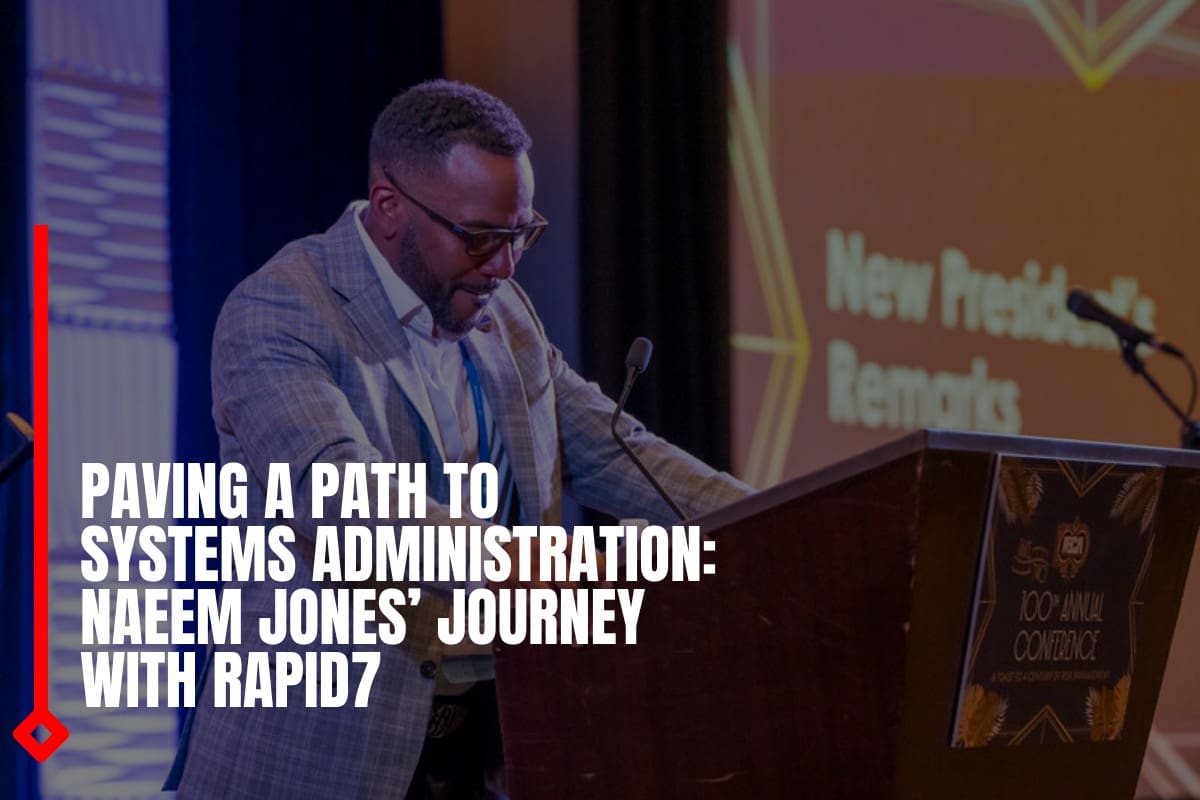
He didn’t break into cybersecurity through a lucky referral or a late-night LinkedIn DM. Naeem Jones got his start the way a lot of overlooked talent does—by finding a program that actually saw him, then putting in the work once the door cracked open.
Before becoming a Systems Administrator at Rapid7, Jones entered the industry through Hack.Diversity, a career accelerator that connects talented Black and Latinx students and early-career professionals with companies serious about building inclusive, equitable workplaces. Rapid7 has been a founding partner of the program since 2017, and Jones’ journey offers a clean, real-world example of what happens when opportunity, culture, and ownership line up.
Finding a way in without shrinking yourself

When Jones joined Hack.Diversity, he and others in his cohort weren’t looking for résumé padding. They wanted real responsibility, real learning, and the chance to grow without having to code-switch their personalities away.
That’s where Rapid7 stood out.
“One of my favorite core values at Rapid7 is ‘Bring You,’” Jones said. “I love having the ability to bring your authentic self every day—and that looks different for everyone.”

For Jones, authenticity looks like competitive gaming. He’s an avid gamer and part of multiple internal groups at Rapid7 where employees bond over video games, media, and shared interests. It’s not just tolerated—it’s welcomed.
“If you think you can beat me in a game,” he joked, “I am here, and I accept the challenge.”
That might sound small, but for early-career professionals—especially those from underrepresented backgrounds—it’s not. Culture isn’t about slogans on a wall. It’s about whether you feel like you belong before you’ve proven yourself.
Hack.Diversity: more than a placement pipeline

Hack.Diversity isn’t a traditional internship program. It focuses on connecting emerging talent with organizations willing to invest not just in skills, but in long-term growth and belonging. The program emphasizes ownership, professional readiness, and exposure to environments where Fellows aren’t treated like temporary help.
Organizations like Hack.Diversity play a growing role in addressing workforce gaps flagged repeatedly by federal labor data. The U.S. Bureau of Labor Statistics continues to show strong demand for IT and cybersecurity professionals, alongside persistent underrepresentation of Black and Latinx workers in technical roles (https://www.bls.gov).
Rather than waiting for hiring systems to fix themselves, Hack.Diversity works upstream—bridging talent to companies prepared to meet them halfway.
Becoming a “Moose” from day one
At Rapid7, employees refer to themselves as “Moose.” It’s not just a mascot thing. A moose can stand alone or move as part of a herd—individual ownership paired with collective impact. It ties directly to one of Rapid7’s five core values: Impact Together.
That mindset showed up early in Jones’ experience.
“Rapid7 emphasized that once you join, you’re part of the team,” Jones said. “Even if you’re an intern, you’re a Moose and will be working alongside others with the same opportunities.”
That wasn’t lip service. A few months into his internship, Jones was put in charge of handling the employee onboarding process—a critical function that directly affects how quickly teams can do their jobs.
“I had ownership of a critical part of the business,” he said. “I was the face of IT and the first person new employees interacted with when getting their devices and learning where to go for help.”
Why IT onboarding actually matters
Onboarding might not sound flashy, but it’s foundational. The faster employees are comfortable with their devices and tools, the faster they can contribute to customer-facing work. At Rapid7, that means helping organizations stay ahead of attackers in an increasingly complex digital threat landscape.
Jones’ role helped accelerate that process.
By efficiently walking new hires through their laptops, security setups, and support channels, he helped teams get productive faster. That operational efficiency ripples outward—supporting product development, customer trust, and ultimately, business outcomes.
It’s a reminder that in tech, impact isn’t always about writing code. Sometimes it’s about making sure the people who do write code aren’t blocked on day one.
Growing from intern to Systems Administrator
Jones didn’t stall after his internship ended. Over five years at Rapid7, he steadily expanded his scope, leaning into one of the company’s quieter strengths: open communication around career development.
Through conversations with managers and mentors, Jones began mapping a path into systems administration. He shadowed colleagues whose work interested him, asked questions, and volunteered for stretch opportunities.
“Mentorship and cross-collaboration never goes away,” he said. “There’s still so much for me to learn from my peers, whether they’re in junior or senior roles.”
That learning goes both ways now.
“I have the opportunity to pass my knowledge along to others,” Jones said. “I’m able to offer tips, tricks, and guidance on processes I’m well-versed in.”
The power of teaching while learning
Jones talks about knowledge-sharing like it’s a responsibility, not a perk.
“I love being able to empower my team—or any partner—to learn from my experiences,” he said. “It’s a privilege to show others how I navigate processes so they can improve and become better.”
That cycle—learning, applying, teaching—is how teams scale without burning out. It’s also how inclusive cultures sustain themselves. When information flows freely instead of being hoarded, people feel safer asking questions and trying new things.
This kind of internal mentorship aligns with broader workforce equity guidance from agencies like the U.S. Department of Labor, which continues to emphasize skill development, career pathways, and on-the-job learning as key to long-term economic mobility (https://www.dol.gov).
Imposter syndrome doesn’t vanish—here’s how he deals with it
Jones doesn’t pretend confidence is automatic. He openly acknowledges a challenge that hits many early- and mid-career professionals hard: imposter syndrome.
“There have been points in my career where I felt paralyzed by it,” he said.
His advice isn’t revolutionary—but it’s honest.
“Always try to partner, learn new skills, and shadow people in roles that interest you,” Jones said. “No matter if it’s a little thing or a big thing, just try.”
He’s realistic about the fact that imposter syndrome may never fully disappear. The key, he says, is not letting it dictate your decisions.
“Never let those feelings block you from learning and growing,” he said. “Even if you ‘fail,’ you’ll still learn something and can carry that experience with you.”
What his journey signals for the tech industry
Jones’ path—from Hack.Diversity Fellow to Systems Administrator—highlights a broader truth the industry is still catching up to: talent is everywhere, but access and trust are not.
Programs like Hack.Diversity, combined with companies willing to offer real ownership and authentic culture, show what’s possible when inclusion is treated as a system, not a side project. That approach aligns with equal opportunity principles outlined by the U.S. Equal Employment Opportunity Commission, which stresses that equitable workplaces require consistent, intentional practices—not one-off initiatives (https://www.eeoc.gov).
For employers, the lesson is straightforward. If you want diverse talent to stay, you have to give them space to grow, room to be themselves, and ownership that actually matters.
For individuals watching from the outside, Jones’ story carries a quieter message: you don’t have to wait until you feel “ready.” Sometimes readiness comes after you step forward.
FAQs
1 What is Hack.Diversity?
Hack.Diversity is a career accelerator that connects Black and Latinx early-career professionals with companies committed to inclusive, equitable workplaces.
2 How long has Rapid7 partnered with Hack.Diversity?
Rapid7 has been a founding member of Hack.Diversity and has partnered with the organization since 2017.
3 What role does Naeem Jones hold at Rapid7 today?
He currently works as a Systems Administrator.
4 What helped Jones grow from intern to full-time role?
Ownership of meaningful projects, mentorship, open communication with managers, and opportunities to shadow other teams.
5 What advice does Jones give about imposter syndrome?
Don’t let it stop you from trying. Partner with others, learn continuously, and treat every experience—success or failure—as growth.