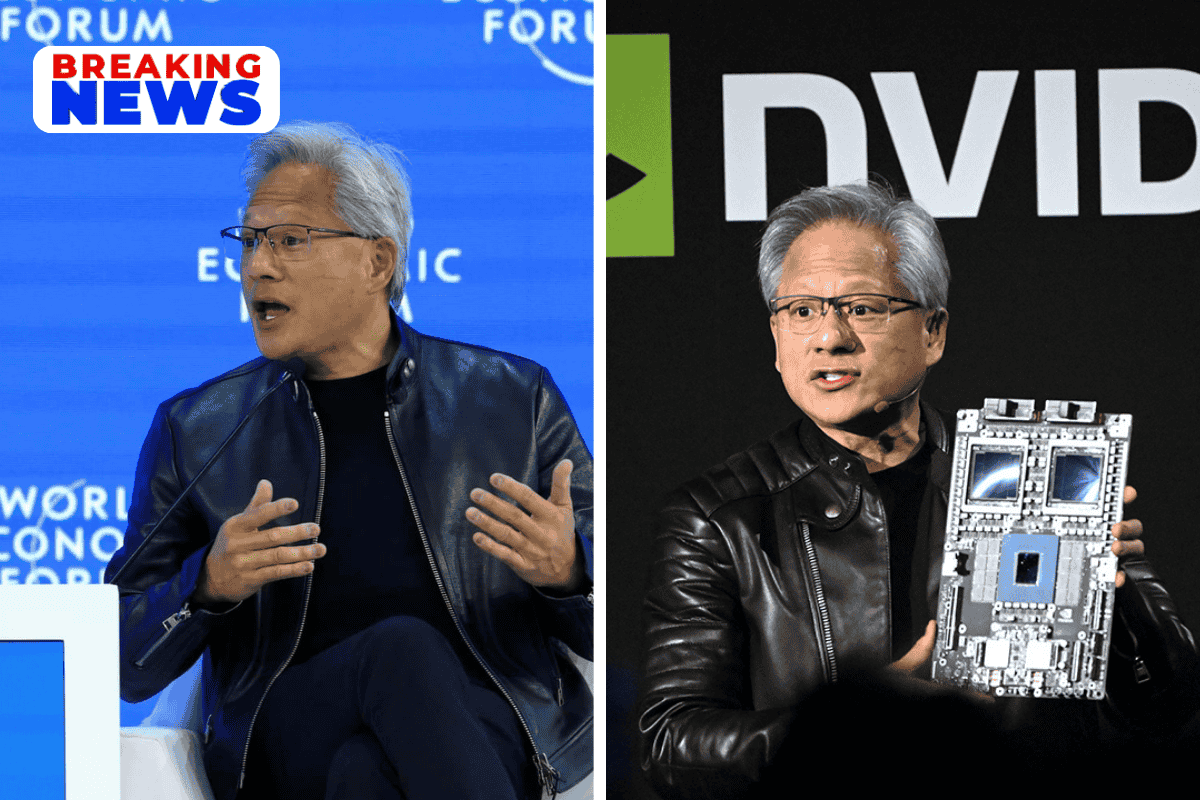
Jensen Huang isn’t buying the bubble talk. As investors fret over whether artificial intelligence is the latest tech cycle racing toward a hard landing, Nvidia’s CEO is striking a very different tone—one rooted in structural change, not speculative excess.
Speaking on Nvidia’s latest earnings call, Huang brushed aside comparisons to past boom-and-bust moments, arguing that what’s happening in AI right now is foundational, not frothy.

“There’s been a lot of talk about an AI bubble,” Huang said. “From our vantage point, we see something very different.” Coming from the man whose company sits at the center of the global AI supply chain, the comment wasn’t exactly shocking. Still, it landed with weight.
Nvidia’s chips power data centers for nearly every major cloud provider—from Google and Amazon to Oracle—and the company’s numbers suggest demand is anything but fragile.
Why Investors Keep Whispering “Bubble”
The anxiety isn’t coming out of nowhere. Over the past two years, spending on AI infrastructure has exploded. Cloud giants are pouring tens of billions of dollars into data centers, networking gear, and high-end GPUs. Critics warn that such spending may be hard to justify if AI-driven revenues don’t ramp up fast enough.

It’s a familiar fear in tech. We’ve seen this movie before—dot-com fiber networks built ahead of demand, smartphone saturation, crypto mining booms that fizzled. The concern is whether AI could follow a similar arc once the initial excitement fades.
Huang’s argument is that AI is different. Not incremental. Not cyclical. Structural.
The First Shift: From CPUs to GPUs
The backbone of Huang’s thesis starts with hardware. For decades, computing revolved around CPUs, with Moore’s Law reliably delivering more power every few years. That model, Huang argues, is hitting physical and economic limits.

“Traditional computing is built around central processors, and it’s reaching its limit,” he told analysts.
AI workloads—training large models, running inference at scale—are fundamentally different. They thrive on parallelism, which is where GPUs dominate. Tasks like search ranking, ad recommendations, data processing, and machine learning are rapidly migrating away from CPU-centric systems toward GPU-accelerated architectures.
This isn’t a nice-to-have optimization. It’s a forced migration. And Nvidia, with its CUDA ecosystem and full-stack approach, is positioned as the toll collector on that transition.
AI Isn’t Just Improving Apps—It’s Creating New Ones
Huang’s second point goes beyond hardware. He argues that AI is no longer just making existing tools better; it’s enabling entirely new categories of software.
Generative AI is the obvious example. Search engines that synthesize answers instead of listing links. Recommendation systems that reason, not just react. Engineering tools that simulate complex systems before a single prototype is built.
These applications didn’t exist a few years ago because the underlying compute simply wasn’t available. Now, they’re becoming core to how companies operate. According to filings and disclosures from firms like Microsoft and Google, AI is increasingly embedded across products, not siloed in experimental labs.
That shift matters because it expands the total addressable market for compute. More applications mean more models, more inference, more demand.
The Rise of Agentic and Physical AI
The third transition Huang outlined is the most ambitious—and the most compute-hungry.
He calls it the rise of “agentic” and “physical” AI. These are systems that don’t just respond to prompts, but can reason, plan, and act with minimal human input. Think coding agents that write and debug software autonomously, or robots that perceive the physical world and make decisions in real time.
These workloads are brutal on infrastructure. They require continuous reasoning, simulation, and feedback loops, all of which push demand for high-performance GPUs even further.
Huang’s bet is that Nvidia’s architecture can support all three transitions—across industries, across AI modalities, and at global scale. It’s a bold claim, but so far, customers seem to agree.
The Numbers Back Him Up—for Now
Nvidia’s latest earnings give Huang plenty of ammunition. The company reported record quarterly revenue of $57 billion, up 62% year over year. For the upcoming quarter, Nvidia forecast $65 billion in revenue, well ahead of what many analysts expected.
Investors liked what they heard. Nvidia shares jumped about 5% in after-hours trading following the earnings release.
CFO Colette Kress summed up the situation with unusual bluntness: “The clouds are sold out. Our GPU installed base is fully utilized.”
That line speaks volumes. Cloud providers aren’t hesitating. They’re scrambling for supply.
| Metric | Latest Quarter |
|---|---|
| Revenue | $57 billion |
| YoY Growth | 62% |
| Next Quarter Forecast | $65 billion |
| After-hours Stock Move | +5% |
Skeptics will argue that parabolic growth always looks structural—until it isn’t. They’ll point out that hyperscalers could eventually slow spending, optimize workloads, or turn to custom silicon. Those risks are real, and even Nvidia acknowledges competition is intensifying.
But Huang’s central point is that AI isn’t a single product cycle. It’s a re-architecture of computing itself. CPUs to GPUs. Static software to generative systems. Passive tools to autonomous agents and machines.
If that framing holds, then today’s spending isn’t excess—it’s groundwork.
Whether history proves him right is an open question. For now, though, the data suggests one thing clearly: the AI infrastructure build-out is far from running out of steam, and Nvidia remains the company everyone has to pay along the way.
FAQs
Q. Why are investors worried about an AI bubble?
They fear that massive spending on AI infrastructure may not deliver enough long-term returns.
Q. What is Jensen Huang’s response to these concerns?
He argues AI represents a structural shift in computing, not a speculative boom.
Q. Why are GPUs replacing CPUs for AI workloads?
GPUs handle parallel processing far more efficiently, which is essential for AI training and inference.
Q. What is “agentic AI”?
AI systems capable of reasoning, planning, and acting with minimal human input.
Q. How did Nvidia perform last quarter?
The company reported $57 billion in revenue, up 62% year over year.