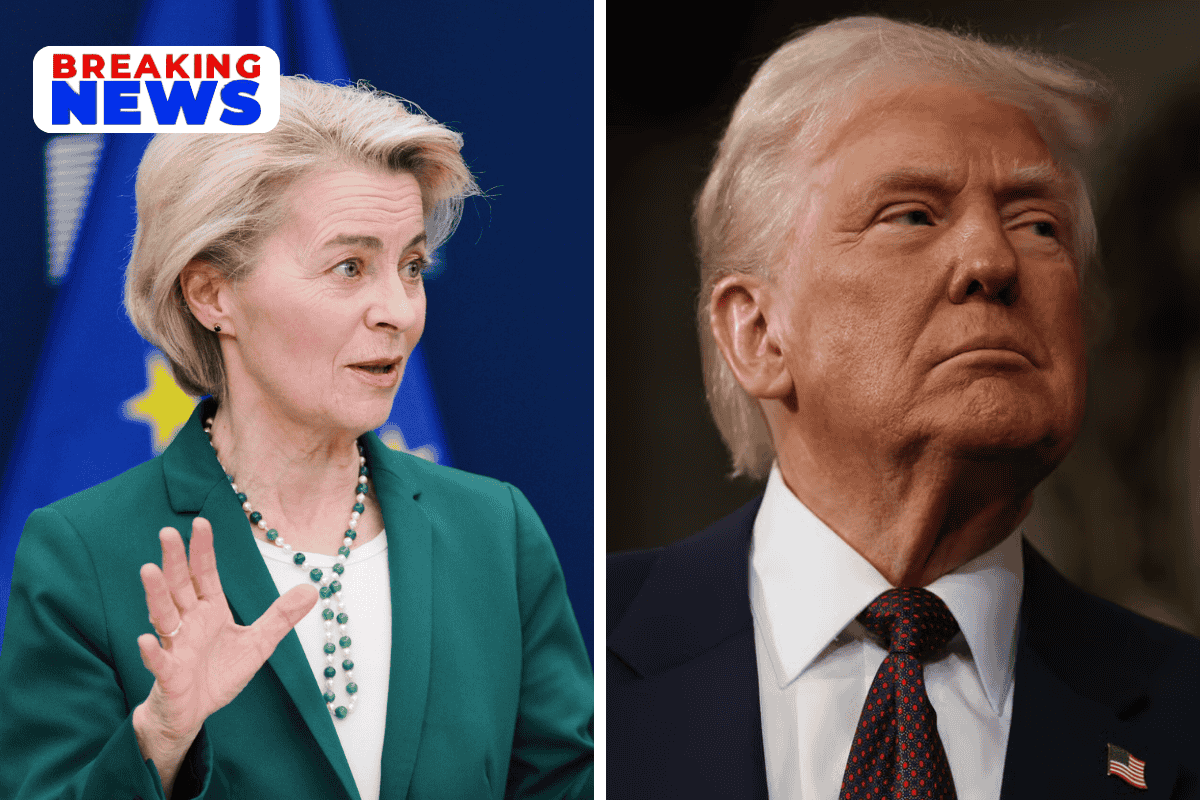
In a startling move, US President Donald Trump threatened to impose tariffs on eight European countries unless they support his controversial plan to purchase Greenland.
The threat, which could see a 10% tariff on imports into the US from February 1, rising to 25% by summer, has caught European leaders by surprise. This move comes amid a period of heightened trade tensions between the US and Europe, with far-reaching implications for businesses on both sides of the Atlantic.

The group of countries potentially affected includes France, Germany, the UK, Denmark, Norway, Sweden, the Netherlands, and Finland. Although President Trump’s actions have prompted some responses from European officials, the big question remains: how will Europe react to these threats?
Could Europe Retaliate with Tariffs?
Just months ago, the US and the European Union (EU) reached an agreement that aimed to stabilize transatlantic trade. This deal, negotiated with President Trump at his golf course in Scotland, avoided an escalation of tariffs, with the EU agreeing to 15% tariffs on American goods rather than the 30% initially threatened by the US. However, Trump’s latest threat could unravel this fragile agreement.
Under the agreement, both parties suspended tariffs while working out the details of their trade relationship. The EU had already prepared a package of tariffs worth €93 billion (£80bn; $108bn) on US goods, including everything from livestock and aircraft parts to whiskey.

These tariffs, however, were suspended as both sides aimed to finalize a broader deal. If the EU fails to ratify this deal or extend the suspension, these tariffs could be reintroduced as soon as February 7, with potentially devastating consequences for US exports.
Despite Trump’s threats of targeting individual European countries, implementing these tariffs would be difficult. As European Commission spokesperson Olof Gill pointed out, goods frequently cross EU borders before reaching their final destination in the US, making it challenging to impose tariffs on specific countries. Gill further emphasized that such tariffs would ultimately harm businesses and consumers on both sides of the Atlantic.
Europe’s “Trade Bazooka”: A Last Resort
In response to economic coercion, the EU has a so-called “trade bazooka,” officially known as the Anti-Coercion Instrument (ACI). This law is designed to counteract foreign countries attempting to interfere with EU member states’ sovereign choices, allowing for an array of retaliatory measures. These measures could include tariffs, restrictions on trade, and reduced access to financial markets.

However, the “trade bazooka” is considered a last resort, with significant risks for the EU itself. Deploying such measures would likely lead to serious economic damage, and the process of launching these actions is far from swift.
Under current EU rules, the European Commission can take up to four months to investigate coercion, followed by negotiations that could last another six months. Even if the Commission were to activate the bazooka, it could be nearly a year before any retaliatory measures are implemented.
Given the political and economic risks of activating the ACI, European leaders are likely to seek diplomatic solutions first, hoping to avoid the full impact of such drastic actions.
The UK’s Position: No Immediate Retaliation
Prime Minister Sir Keir Starmer has expressed a desire to avoid escalating tensions with the US over Trump’s Greenland threat.
In a speech on Monday, Starmer made it clear that the UK should not be drawn into a trade war, acknowledging that the use of trade taxes “against allies” is problematic. However, he also stated that “a tariff war is in nobody’s interests,” emphasizing his preference to prevent such a situation from unfolding.
Despite this, the UK has several other potential levers it could use if the EU and the US fail to reach an agreement. One option is for the UK to increase its Digital Services Tax (DST), which targets large tech companies, including American giants like Amazon, Facebook (Meta), and Google.
The current DST rate is 2% and applies to tech firms with £500 million in worldwide sales and £25 million in UK revenue. This move would likely exacerbate tensions with the US, particularly in the tech sector, but would serve as a form of retaliation.
Legal Challenges to Trump’s Tariffs
At present, the legality of Trump’s proposed tariffs is uncertain. The US Supreme Court is set to rule on whether the president has overstepped his authority in imposing tariffs using the International Emergency Economic Powers Act (IEEPA). This includes the “retaliatory” tariffs that Trump introduced last year, under which American businesses importing British goods face a 10% tax.
If the Supreme Court rules that Trump’s use of the IEEPA is unconstitutional, it could significantly undermine his ability to impose such tariffs. This decision could provide some relief to UK businesses, but much remains in limbo until a ruling is made.
What’s Next for UK and EU Trade?
While the immediate future remains uncertain, both the UK and the EU are likely to focus on preventing further escalation of the trade conflict. The European Commission’s priority will be to ensure that European economic interests are protected while avoiding a full-blown tariff war.
For the UK, diplomatic efforts will focus on securing favorable trade terms with both the EU and the US, avoiding retaliatory actions while also exploring other trade avenues.
The EU’s “trade bazooka” may remain largely unused unless Trump escalates matters further. For now, both sides are likely to continue diplomatic negotiations in hopes of finding a compromise that avoids economic retaliation.
FAQ
Q1: What tariffs has Trump threatened on Europe?
A1: Trump has threatened to impose a 10% tariff on imports from eight European countries starting February 1, with the tariff rate increasing to 25% later in the year unless these countries support his plan to purchase Greenland.
Q2: Can the EU retaliate with tariffs?
A2: Yes, the EU has a range of options, including tariffs on American goods, but implementing them would be complex and could harm European businesses as well. The EU has a “trade bazooka” law that allows for severe retaliatory measures but would likely only deploy it as a last resort.
Q3: What is the UK’s stance on the tariff threat?
A3: UK Prime Minister Sir Keir Starmer has ruled out immediate retaliatory tariffs against the US. He emphasized the need to avoid a trade war and focus on finding diplomatic solutions to the conflict.
Q4: What is the EU’s “trade bazooka”?
A4: The “trade bazooka” refers to the EU’s Anti-Coercion Instrument, which allows for retaliatory measures such as tariffs and trade restrictions against countries that try to force the EU or its member states into making sovereign decisions. However, it is considered a last resort.
Q5: What legal challenges does Trump’s tariff face?
A5: The US Supreme Court is set to rule on whether Trump’s tariffs, imposed under the International Emergency Economic Powers Act, are legal. The outcome could impact the validity of these tariffs, including those targeting British goods.