In a surprising move that reverberated across the globe, US President Donald Trump authorized the sale of Nvidia’s H200 artificial intelligence (AI) chips to China, sparking intense debates on both sides of the Pacific. The decision, which is part of a broader strategy to regulate US chip exports to China, led to concerns over national security and the future of the US-China tech rivalry.
The H200 chips, while powerful, are not the most advanced in Nvidia’s arsenal but represent a significant leap over the chips currently available in China. The approval has ignited a backlash in the US, where lawmakers fear it could erode American technological dominance, while in China, some saw it as a sophisticated strategy to make Beijing reliant on US technologies in crucial sectors like semiconductors and AI.
The Political Divide: National Security vs. Diplomatic Strategy

Trump’s decision to allow the sale of the H200 AI chips to China signals a potential shift in US tech policy. For many in the US, this move seemed like a break from bipartisan efforts that aimed to limit China’s access to cutting-edge technologies.
The so-called “small yard, high fence” strategy, employed by the Biden administration, seeks to prevent China from accessing technologies critical to national security, yet this recent development suggested a more flexible approach.
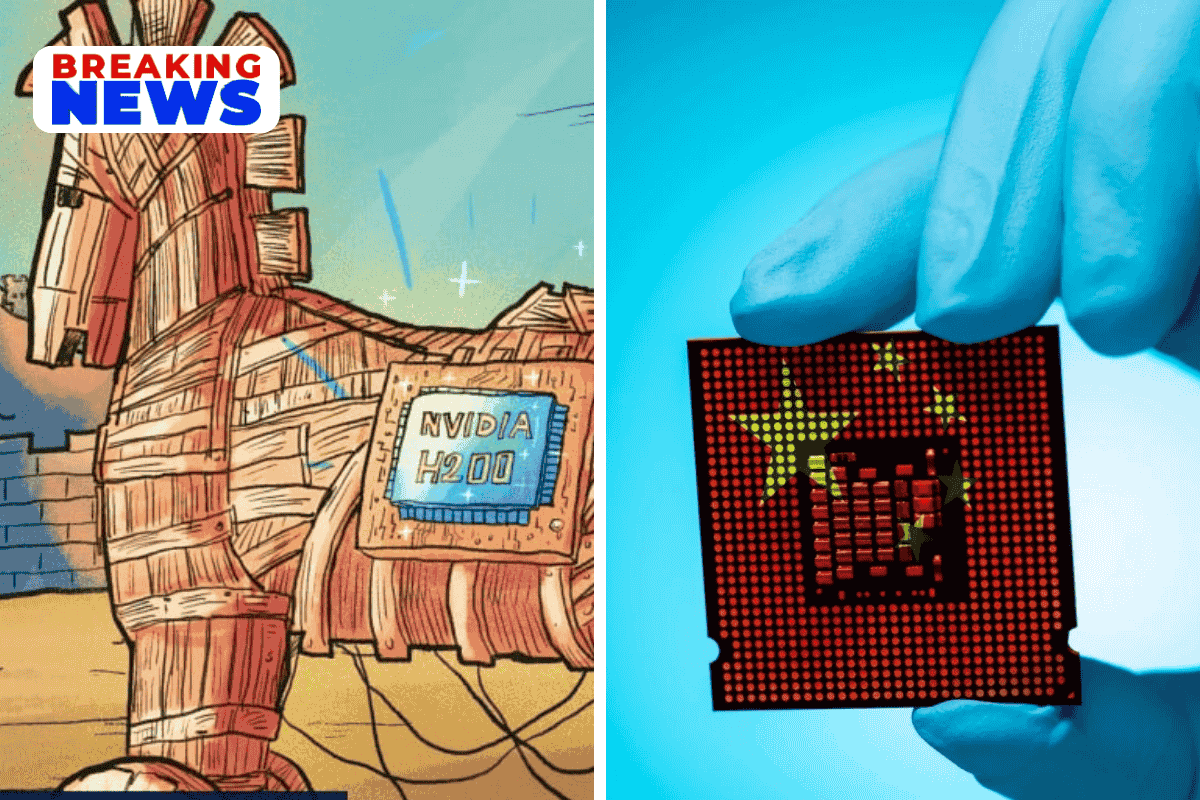
On the other hand, Chinese experts have viewed the move as a “Trojan horse” strategy by the US to deepen China’s dependence on American tech in high-stakes areas such as semiconductors and AI.

Some also speculated that the decision reflected US pragmatism, acknowledging the realities of the global semiconductor industry and even signaling an attempt to stabilize US-China relations ahead of future diplomatic visits between President Trump and President Xi Jinping.

The US-China Tech Rivalry: What’s at Stake?
While the sale of the H200 chip might seem like a minor shift, experts argue that it is unlikely to fundamentally change the trajectory of the US-China tech competition. Over the years, China has made significant advancements in chip manufacturing, chip design software, and other related technologies, paving the way for a new phase in the global semiconductor ecosystem.
Professor Zhao Minghao of Fudan University emphasized that China is building a self-sustaining semiconductor ecosystem, which could eventually lessen the country’s reliance on foreign technologies.

Despite this, the US is determined to maintain its technological superiority in the long run. The Trump administration’s approach appears to be one of selective engagement, allowing the sale of lower-tier AI chips to China while blocking access to more advanced technologies, like Nvidia’s Blackwell and Rubin chips. This is seen as part of a “calibrated containment strategy,” where the US aims to balance national security concerns, economic interests, and diplomatic relations.
A More Complex Tech Containment Strategy?
Experts predict that the US-China tech competition is evolving into a more complex battle over technological ecosystems, with both countries striving to dominate the computing power architectures of the future.
The H200 chip, though not the most advanced on the market, still represents a significant leap forward in AI capabilities. Yet, its sale to China may reflect a more transactional approach from the US, where certain technologies are selectively allowed for export based on security considerations.
Sun Chenghao, a fellow at Tsinghua University, argued that while the US may appear to be relaxing restrictions on some AI technologies, the overarching trend is one of “tech decoupling.” Even with this limited easing of restrictions, the US is likely to continue prioritizing national security while imposing strict licensing requirements to control which technologies reach China.
Will the H200 Decision Change China’s AI Trajectory?
Despite the green light on the H200 chips, China is not expected to change its course on technological self-sufficiency. Beijing’s efforts to reduce its dependence on US technologies are intensifying, especially as its AI industry continues to progress. Research shows that the gap between the US and Chinese AI large language models is steadily narrowing, and China’s domestic semiconductor industry is growing in both capacity and sophistication.
The Chinese government is also focusing on domestic innovation, with a new five-year plan emphasizing breakthroughs in core technologies such as integrated circuits, machine tools, and advanced materials. In the meantime, China’s strategy continues to focus on developing scalable, homegrown technologies that can meet its AI ambitions, even if they are not yet on par with the US’s top-tier chips.
FAQ
Q1: What are the implications of Trump’s decision to approve H200 chip sales to China?
A1: Trump’s decision to approve the sale of Nvidia’s H200 chips to China has raised concerns in the US about national security and technological dominance. While some see it as an olive branch in US-China relations, others believe it could deepen China’s reliance on American technologies.
Q2: How will this decision affect the US-China tech competition?
A2: The sale of the H200 chip will likely not change the trajectory of the US-China tech rivalry. Both countries continue to advance their own technologies, and while the US remains ahead in high-end AI and semiconductor technologies, China is making significant progress in developing its own capabilities.
Q3: Why is China focused on developing its own technology instead of relying on the US?
A3: China aims to achieve technological self-sufficiency in critical sectors like AI and semiconductors. This goal is driven by a desire to reduce reliance on foreign technologies, particularly from the US, which has imposed restrictions on access to advanced chips and equipment.
Q4: What is the “small yard, high fence” strategy, and how does it relate to this decision?
A4: The “small yard, high fence” strategy refers to the Biden administration’s policy of limiting China’s access to key technologies while allowing for broader trade and economic interactions. Trump’s decision to approve the H200 chip sale may be seen as a shift away from this strategy, allowing more flexibility in tech exports.
Q5: Will China’s AI industry be able to catch up to the US?
A5: While China’s AI industry is progressing rapidly, especially in large language models and chip manufacturing, experts believe that the US will continue to maintain a generational lead in high-end technologies. However, China is likely to continue developing “good-enough, scalable” technologies to meet its needs and expand AI adoption.