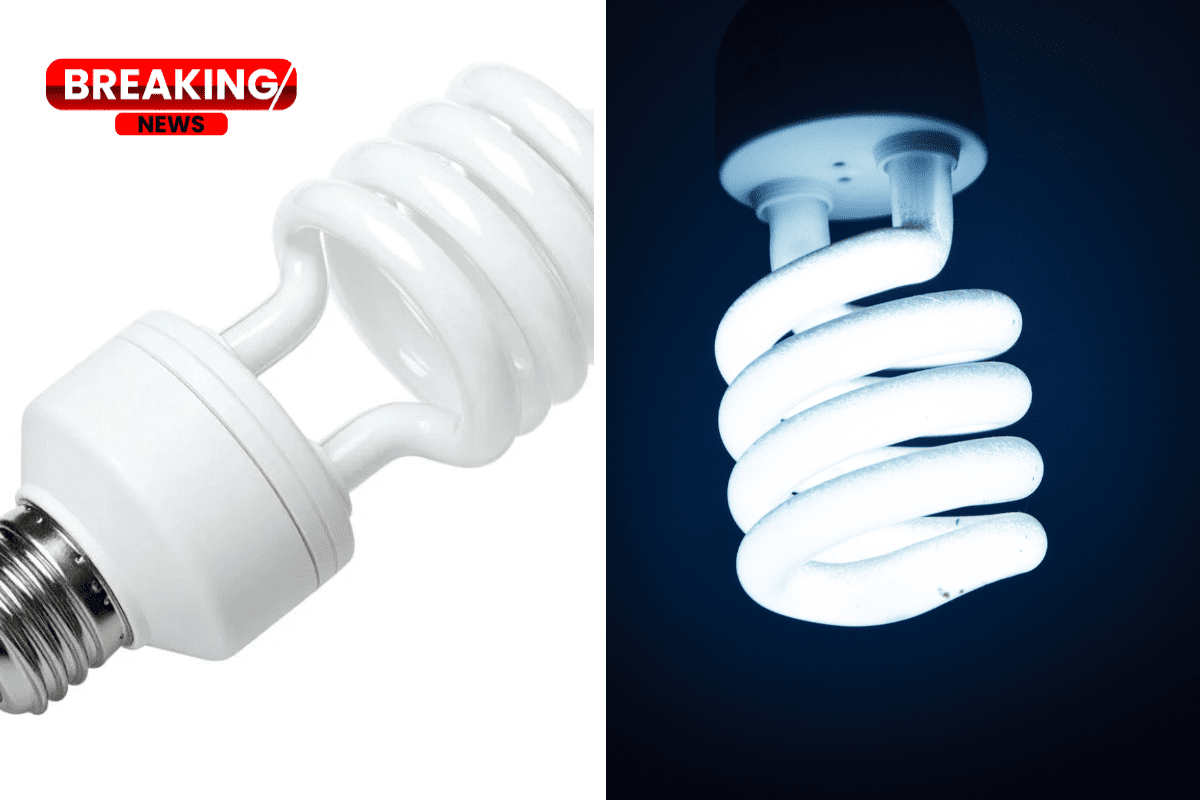
Walk down the lighting aisle of an Illinois hardware store this year and you’ll notice something missing. Those curly, spiral-shaped compact fluorescent bulbs—the ones Americans were once urged to buy to “save the planet”—are officially on their way out.
As of January 1, one of nearly 300 new Illinois laws took effect banning the sale and distribution of compact fluorescent light bulbs (CFLs) across the state. It’s a quiet change, but it marks a sharp turn in how lawmakers now think about energy efficiency, environmental risk, and what belongs in people’s homes.
What Illinois’ new CFL ban actually does

The ban comes from House Bill 2363, introduced in February 2023 by State Rep. Nicholas Smith, a Democrat from Chicago, and signed into law by Gov. J.B. Pritzker in August 2024.
Starting this year, Illinois retailers can no longer sell or distribute screw-base and bayonet-base compact fluorescent lamps. These are the most common CFLs found in table lamps, ceiling fixtures, and floor lamps.
The law doesn’t stop there. Restrictions on pin-base compact fluorescents and linear fluorescent lamps—the long tube-style lights often used in offices, schools, and commercial spaces—are scheduled to begin in 2027.

State officials say the phased approach is meant to give businesses time to adapt, while nudging consumers toward safer alternatives, mainly LEDs.
Full legislative language for HB 2363 is available through the Illinois General Assembly at https://www.ilga.gov.
Why lawmakers targeted fluorescent bulbs
Supporters of the ban point to a problem that’s been hiding in plain sight for years: mercury.

Fluorescent bulbs contain small amounts of mercury, a toxic heavy metal. When disposed of improperly—and most of them are—that mercury can leak into soil and water.
According to a report from the Public Interest Research Group (PIRG), roughly three out of four fluorescent lamps are thrown away incorrectly, rather than recycled through hazardous waste programs. That statistic became a key talking point during legislative debates.
State Sen. Adriane Johnson, the bill’s Senate sponsor, said the environmental and health risks made action unavoidable. Mercury exposure is linked to neurological damage, especially in children, and cleanup costs often fall on taxpayers.
Information on mercury risks from household products is also outlined by the U.S. Environmental Protection Agency at https://www.epa.gov.
Not everyone is cheering the change
Even lawmakers who voted “yes” acknowledged the downside.
State Rep. Nicole La Ha, a Republican from Homer Glen, supported HB 2363 but warned about piling costs and red tape onto small businesses.
“Any time that we have unfunded mandates or things that are going to affect our small businesses, or there’s more red tape that we have to push people through, I’m not always going to be very excited about those things,” La Ha told The Center Square.
That concern echoes beyond Springfield. While LEDs are now cheaper than they were a decade ago, they still cost more upfront than CFLs in some cases. For families already squeezed by higher food, gas, and utility bills, even small price differences matter.
The irony: CFLs were once the green solution
There’s a certain historical whiplash to all of this.
Back in 2006, when former Vice President Al Gore’s documentary An Inconvenient Truth hit theaters, CFLs were treated like environmental heroes. Gore famously urged Americans to swap out incandescent bulbs for compact fluorescents, and environmental groups across the country followed suit.
At the time, CFLs used far less energy and lasted longer than traditional bulbs. LEDs existed, but they were expensive, harsh-looking, and nowhere near ready for mass adoption.
Fast forward to 2026, and the technology equation has flipped. LEDs now last longer than CFLs, consume even less energy, contain no mercury, and cost a fraction of what they once did.
The CFL ban isn’t so much a rejection of energy efficiency—it’s an admission that the “green” solution of yesterday isn’t good enough anymore.
A national trend Illinois didn’t start
Illinois isn’t blazing a trail here. It’s catching up.
Vermont became the first U.S. state to approve a fluorescent bulb ban back in 2022, setting a precedent other states have been watching closely. Federal efficiency standards have also tightened in recent years, gradually squeezing older lighting technologies out of the market.
Tosi Ufodike, a former Illinois House candidate and current Republican contender for 2026, pointed to Vermont as proof that the shift is already underway nationwide.
“There’s a growing trend to have energy-efficient LED lighting,” Ufodike said. “Of course, we always want to have energy-efficient lighting and resources, but I always look at, ‘What’s the cost?’”
That cost question resonates in suburban districts, where voters may not oppose environmental goals but are increasingly wary of policies that raise everyday expenses.
“They’re worried about gas. They’re worried about putting food on the table,” Ufodike added. “As long as it’s done with the taxpayer in mind, then I’m ok with it.”
What consumers and businesses should expect next
For most Illinois residents, the transition will be subtle. Many stores had already begun shrinking CFL inventory as LEDs took over shelf space. When existing stock sells out, it simply won’t be replaced.
Businesses that rely heavily on fluorescent lighting—warehouses, schools, hospitals—have a few more years to prepare before the 2027 restrictions kick in. Recycling programs for existing bulbs will remain critical during the transition period.
The Illinois Environmental Protection Agency provides guidance on proper disposal and recycling of fluorescent bulbs at https://epa.illinois.gov.
The bigger picture
The CFL ban is a reminder of how fast “common sense” environmental policy can change. What was once heavily promoted is now viewed as a liability. And while LEDs may be the clear winner today, lawmakers are clearly leaving room to revisit standards again if technology or costs shift.
FAQs
Q. Are CFL bulbs illegal to own in Illinois?
No. The law bans sale and distribution, not possession or use of existing bulbs.
Q. When do other fluorescent bulbs get banned?
Pin-base and linear fluorescent lamp restrictions begin in 2027.
Q. Why are CFL bulbs considered dangerous?
They contain mercury, which can contaminate the environment if not disposed of properly.
Q. What should I replace CFLs with?
LED bulbs are the recommended alternative. They’re more efficient and mercury-free.
Q. Does the ban apply nationwide?
No. This is a state-level law, though other states have passed or are considering similar bans.